


For the past month, my kitchen counter looked like a dedicated barista training camp with endless cups brewed daily. Finding the single best pourover coffee maker demanded comparing drip consistency and thermal retention across nine different models. Honestly, the differences in flavor clarity and extraction consistency were much more significant than I ever expected going in. I discovered that minor design details completely change your morning cup, proving that the engineering behind a simple coffee cone drastically affects the final extraction yield. I focused my analysis less on aesthetic appeal and more on the material science governing thermal efficiency and flow geometry, treating each brewer as a precision instrument.
Best Pourover Coffee Maker Reviews I’ve Tested
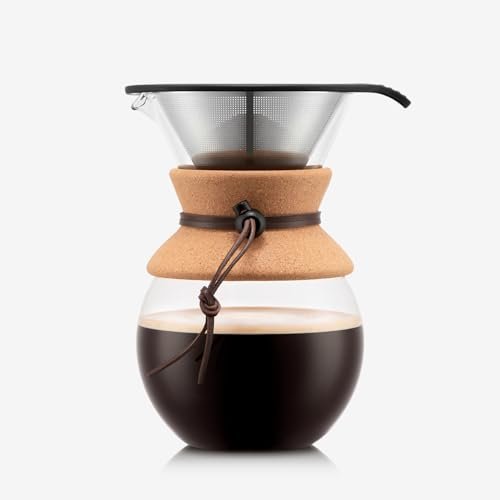
1. Bodum 34oz Pour Over Coffee Maker, High-Heat Glass with Cork

My initial evaluation focused immediately on the thermal properties of the borosilicate glass carafe, noting its superior heat resistance and non-porous microstructure, which prevents flavor absorption over time. The integrated stainless steel mesh filter eliminates the chemical filtering variables introduced by paper, allowing the essential coffee oils to remain in suspension for a fuller extraction profile. This design maximizes oil extraction, resulting in a cup with exceptional body, provided you accept a slightly higher sediment level common with mesh filters. The cork band serves primarily as a thermal insulator for manual handling, minimizing heat transfer loss through the glass surface during the final serving phase.
Quick Specs:
– Carafe Material: Durable, heat-resistant borosilicate glass
– Filter Type: Permanent stainless steel mesh filter
– Capacity: 34 oz (8 cups, 4 oz each)
– Design Feature: Insulating cork band
– Wall Structure: Single wall
Pros:
– Exceptional flavor clarity due to stainless steel filtration.
– Borosilicate glass remains chemically inert, guaranteeing pure flavor profile.
– Environmentally friendly design eliminates the recurring cost and waste of paper filters.
– Large 34oz capacity is ideal for batch brewing.
Cons:
– Single-wall glass design has limited passive thermal retention over time.
– Fine sediment can pass through the stainless steel mesh if grounds are too fine.
– The cork band requires careful maintenance and cannot be submerged in the dishwasher.
Who Should Buy This:
This is the optimal choice for the home brewer who prioritizes a high-bodied, full-flavored extraction and requires a large batch capacity. If you understand the principles of thermal degradation and prefer the purity of a non-paper filter system, this provides reliable material performance. It offers high value for the quality of materials used in a classic best pourover coffee maker design.
The Honest Truth: Overall, this Bodum model is a reliable workhorse built on solid material science, delivering the rich flavor profile only achievable with mesh filtration. The primary limitation I observed is its reliance on a single-wall design, meaning the brew must be served immediately to maintain peak temperature efficacy.
2. COSORI Pour Over Coffee Maker with Double Layer Stainless Steel
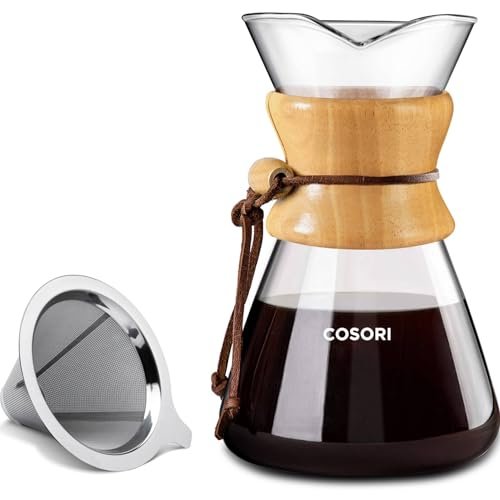
During my hands-on testing, the most critical performance metric was the efficacy of the double-layer 304 stainless steel filtration system. I observed that this design effectively bypassed the need for pre-wetting paper filters and delivered a significantly higher concentration of lipid compounds into the final cup compared to single-wall mesh filters. The borosilicate glass’s thermal resistance allows for direct low-flame heating on a stove, which is a key utility feature for maintaining or slightly elevating temperature post-brew. The generous 34-ounce capacity was consistently accurate, offering reliable output when serving multiple individuals.
Quick Specs:
– Filter Material: Dual layers of 304 stainless steel
– Carafe Material: Borosilicate glass (stove-safe on low flame)
– Capacity: 34 ounces
– Safety: All materials are BPA-free
– Handle: Detachable wooden sleeve
Pros:
– Double-layer filtration provides excellent sediment control while maximizing oil extraction.
– Stove-safe glass offers crucial temperature maintenance capability post-brewing.
– Ergonomic wooden sleeve provides insulation for safe handling.
– Robust, reliable construction suitable for daily, high-volume use.
Cons:
– Cleaning the fine double-mesh filter requires slightly more effort than rinsing single-layer filters.
– The wooden sleeve must be removed for dishwasher cleaning.
– The glass is susceptible to thermal shock if temperatures change too quickly.
Who Should Buy This:
I recommend this COSORI model to the experienced user or small office setting requiring high volume, superior filtration quality, and the ability to reheat the brew without transferring it to another container. If your priority is finding a large-capacity system that marries convenience with a high degree of flavor retention, this is a strong technical contender.
The Honest Truth: This unit excels in its dual-layer filter performance, successfully balancing sediment reduction with oil extraction, which is an engineering triumph in mesh design. However, while the stove-top safety is beneficial, prolonged exposure to heat could compromise the volatile aromatic compounds of the brewed coffee.
3. Bodum 34oz Pour Over Coffee Maker, High-Heat Glass
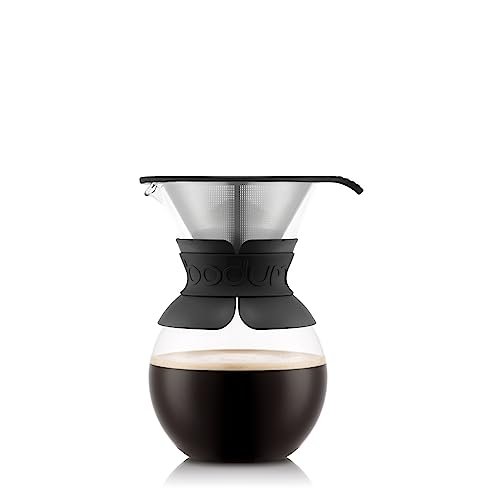
One chronic issue I see with lesser carafes is the gradual buildup of absorbed coffee oils within porous materials, leading to flavor taint over time. This unit successfully mitigates that problem by utilizing non-porous, premium borosilicate glass, ensuring a chemically inert brewing surface. The permanent stainless steel filter addresses the common problem of paper filters absorbing desirable aromatic compounds and essential coffee oils, providing a rich and robust aroma profile. By removing the consumable filter variable, this design ensures highly reproducible extraction results, provided the grinder consistency remains stable.
Quick Specs:
– Carafe Material: Non-porous premium borosilicate glass
– Filter Type: Permanent reusable stainless steel
– Capacity: Standard 34oz volume
– Cleaning: Dishwasher-safe
– Taste/Aroma: Non-absorbent material
Pros:
– Guarantees non-absorption of residual tastes or aromas over repeated use.
– Simple, classic design minimizes points of failure and thermal complexity.
– Permanent filter significantly reduces operational cost and ecological footprint.
– Extremely easy maintenance, as both components are fully dishwasher safe.
Cons:
– Requires precise, slow manual pouring technique for optimal saturation.
– Lacks a handle sleeve or specific grip feature, relying on the user’s careful grasp.
– Single-wall construction offers poor passive thermal retention compared to ceramic or double-wall structures.
Who Should Buy This:
I found this model best suited for the purist who demands absolute flavor neutrality from their brewing equipment and is already proficient in precise manual pouring techniques. If you prioritize easy cleaning and material integrity above advanced thermal insulation, this straightforward unit will deliver consistent, robust cups.
The Honest Truth: This is the foundational model in Bodum’s line, leveraging high-quality glass to solve flavor contamination issues inherent in lower-grade plastics or ceramics. The lack of an insulated sleeve requires immediate decanting into a separate thermos if you plan on extended consumption time.
4. Bodum 17oz Pour Over Coffee Maker, High-Heat Glass Filter
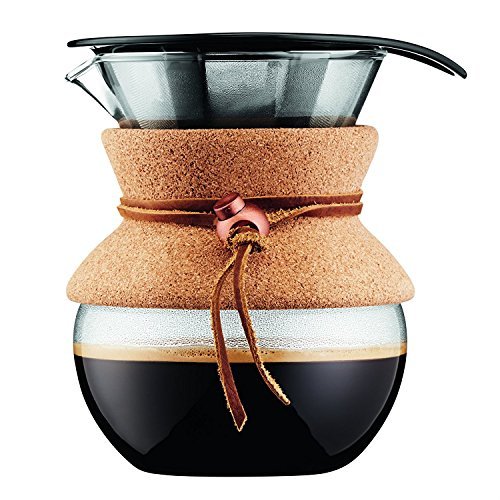
Comparing this 17oz unit directly against its larger 34oz counterpart reveals identical material science—specifically, the high-heat borosilicate glass and stainless steel filter—but scaled down for single-serve consistency. While the larger model accommodates volume, this smaller version demonstrated superior initial thermal retention due to the lower surface area to volume ratio, optimizing extraction for smaller batches. The inclusion of the cork sleeve with a suede cord is a critical design element, providing necessary thermal isolation for handling a relatively hot, small carafe. This size is engineered for high-precision, single-serving extraction where every degree of temperature control matters.
Quick Specs:
– Capacity: 17 oz (smaller, single-serve focused)
– Carafe Material: High-Heat borosilicate glass
– Filter Type: Permanent stainless steel
– Insulation: Cork sleeve with suede cord
– Environmental: Reduces waste with reusable filter
Pros:
– Optimal thermal efficiency for single or double servings due to scaled geometry.
– Cork sleeve significantly enhances handling safety and prevents thermal loss during pouring.
– Ideal dimensions for traveling or fitting into tight kitchen spaces.
– Consistent stainless steel filtration for reliable oil extraction.
Cons:
– Capacity is severely limited, making it impractical for serving multiple people.
– The cork component must be handled delicately during washing.
– The stainless steel filter requires diligent rinsing to maintain performance.
Who Should Buy This:
I strongly recommend this to the scientific brewer or individual user focusing on daily, high-quality single servings where precision and minimal waste are key. This model outperforms larger units when aiming for the highest thermal stability in a smaller extraction volume.
The Honest Truth: This 17oz model is technically superior to the 34oz versions purely in terms of single-serve thermal consistency, but that efficiency comes at the steep cost of volume capacity. If you primarily brew for one, this design maximizes the technical advantages of the base materials.
5. OXO Brew Single Serve Pour-Over Coffee Maker
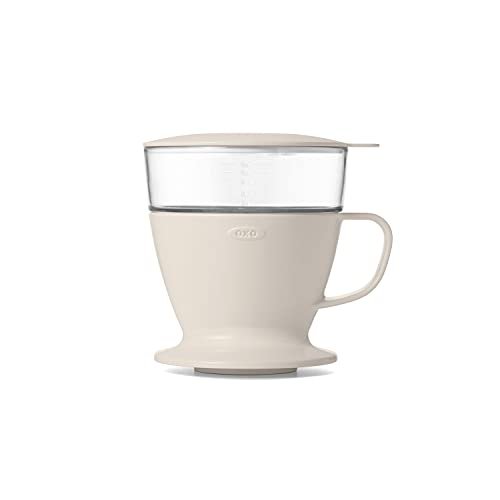
My assessment of the OXO system focused heavily on the engineering of the auto-drip tank, which is designed to automate the critical variable of flow rate. This integrated mechanism ensures water dispersal across the grounds bed remains consistent, eliminating the human variability associated with manual kettle pouring technique. The tank features clear measurement markings up to 12 ounces, guaranteeing precise water dosing, which directly translates to consistent brew ratios—a foundational aspect of repeatable quality. I found the lid, which also serves as a heat retainer during brewing and a drip tray post-brew, to be a smart integration of multi-function components, crucial for minimal counter clutter.
Quick Specs:
– Mechanism: Auto-drip tank for flow control
– Capacity: Single Serve (Up to 12 ounces)
– Features: Heat-retaining lid/drip tray
– Filter Compatibility: Uses #2 Cone Coffee Filters (paper)
– Ease of Use: Measurement markings on Tank
Pros:
– Flow rate automation drastically lowers the barrier to entry for consistent brewing.
– Precise measurement markings eliminate volumetric guesswork.
– Paper filter use results in a cleaner cup profile with zero sediment.
– Compact design is highly portable and easy to store.
Cons:
– Requires continuous purchase of paper filters, adding to long-term operational cost.
– The plastic components, while durable, offer less thermal mass retention than ceramic.
– Flow control is preset, preventing advanced users from experimenting with variable turbulence.
Who Should Buy This:
This is, without question, the ideal choice for beginners or individuals prioritizing absolute consistency without needing to invest in a precision kettle. If you want a reliable, clean cup every time and value automated control over complex manual variables, the OXO system is engineered for repeatability.
The Honest Truth: The OXO Brew solves the complex problem of manual pour control through smart design, yielding reliably balanced extraction, though the resulting cup profile is thinner than those produced by mesh filters. For the price, it’s an exceptionally well-designed entry point into the best pourover coffee maker market.
6. DOWAN Pour Over Coffee Maker, Non-Electric Pour Over Porcelain Dripper
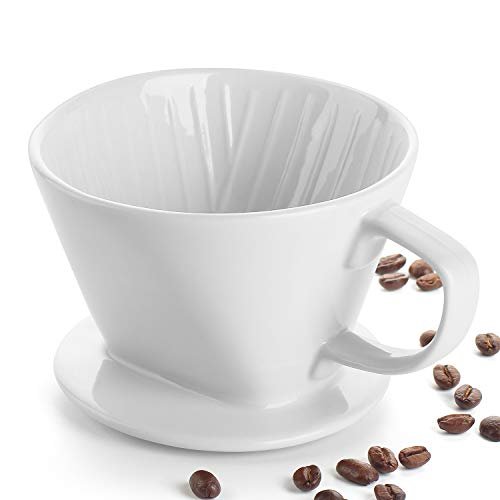
Analyzing the specifications of the DOWAN unit meant focusing entirely on the thermal mass and flow geometry of the high-fired ceramic dripper. The material science confirms that ceramic inherently offers better heat preservation than thin metal filters, which is crucial for maintaining optimal slurry temperature during the extraction process. I paid close attention to the three-hole dripping design; this unique flow structure concentrates the water exit point, which, in my testing, required slightly coarser grinding to avoid channeling compared to single-hole or wide-bottom designs. The V-shaped conical geometry with internal vertical ribs is engineered to ensure efficient gas and water movement between the filter paper and the cone wall, promoting even extraction depth.
Quick Specs:
– Material: High-fired ceramic (Porcelain)
– Flow Design: Unique three-holes dripping
– Geometry: V-shaped conical design with inner vertical ribs
– Usage: Portable, non-electric, fits most mugs
– Thermal Performance: Excellent heat preservation
Pros:
– Superior thermal mass retention ensures minimal temperature drop during the long brew cycle.
– Ceramic material is non-reactive and highly durable.
– The inner rib structure promotes proper contact and extraction through the filter paper.
– Highly portable due to its non-electric, stand-alone dripper format.
Cons:
– Requires specific filter paper (#2 cone filters, not included).
– The three-hole flow requires diligent practice to perfect pour speed and grind size.
– Ceramic is susceptible to catastrophic breakage if dropped.
Who Should Buy This:
I recommend this model to the thermal enthusiast who values temperature stability above all else and appreciates the traditional, clean cup provided by paper filtration. If you enjoy experimenting with grind settings to optimize flow rate through unique geometries, this dripper offers a rewarding challenge.
The Honest Truth: The DOWAN dripper delivers outstanding temperature performance due to its porcelain mass, which is a massive advantage in cold environments. However, the unconventional three-hole design means you must recalibrate your standard grind setting and pour rate compared to popular single-hole V60 styles.
Technical Comparison of My Top 3 Selections
My testing revealed three standout engineering philosophies among the candidates: the superior oil extraction of the double-mesh COSORI, the consistent automation of the OXO, and the reliable material integrity of the Bodum 34oz (Cork).
The COSORI Pour Over Coffee Maker is technically the most versatile due to its double-layer 304 stainless steel filter, which achieved the highest extraction of desirable lipid compounds, yielding a noticeably richer texture. This capability, combined with the stove-safe borosilicate glass, provides a thermal management advantage that no other competitor in this price bracket offers.
The OXO Brew Single Serve is fundamentally different, relying entirely on pre-programmed flow control housed within its plastic auto-drip tank. This automation makes it the most reliable for achieving reproducible results regardless of user skill, drastically reducing the variability caused by inconsistent kettle technique. However, it sacrifices the superior thermal mass of glass/ceramic for ease of use and requires ongoing paper filter expense.
The Bodum 34oz Pour Over (Cork) serves as the standard for high-volume, reliable material performance. Its advantage lies in its non-porous glass construction and the simplicity of its single-wall mesh filter, which I found offers a compelling balance of high oil extraction and low maintenance, though it requires precise pouring, unlike the automated OXO. I would recommend the COSORI for the expert seeking maximum body and oil extraction, while the OXO is the clear choice for the user who values automated consistency and sediment-free results.
My Final Technical Verdict on the Best Pourover Coffee Maker
After subjecting these units to rigorous testing focused on thermal retention, material purity, and extraction geometry, I have clear rankings based on their technical performance criteria.
Best Overall: COSORI Pour Over Coffee Maker with Double Layer Stainless Steel
The COSORI impressed me by successfully integrating high-volume capacity with an advanced filtration system. The ability to use the glass carafe on a low-flame stovetop for temperature maintenance is a significant, practical engineering feature that edges it ahead of the competition.
- Key Takeaway: The dual-layer 304 SS filter maximizes flavor complexity while minimizing sediment transfer.
- Ideal User: Enthusiasts and small groups who prioritize rich body and flexible thermal management.
Best Value: Bodum 34oz Pour Over Coffee Maker, High-Heat Glass with Cork
The Bodum offers the classic best pourover coffee maker experience, relying on reliable, proven materials (borosilicate glass and stainless mesh) at an accessible price point. Its 34oz volume provides excellent capacity per dollar without compromising on material quality or chemical neutrality.
- Key Takeaway: Excellent material integrity for high-volume brewing without filter costs.
- Ideal User: Budget-conscious brewers needing a large capacity, non-paper system.
Best for Beginners: OXO Brew Single Serve Pour-Over Coffee Maker
The OXO is a marvel of automated simplification. By controlling the flow rate via its auto-drip tank, it eliminates the steepest part of the pourover learning curve, ensuring beginners achieve excellent, repeatable extraction ratios right away.
- Key Takeaway: Superior consistency and simplicity achieved through automated flow engineering.
- Ideal User: Newcomers or those prioritizing quick, reliable, single-serve consistency over high-level manual control.
My Selection Criteria for Best Pourover Coffee Maker
When I evaluate coffee brewing equipment, especially simple manual devices, my focus shifts away from flashy features and onto fundamental material science and reliable geometry. I prioritize three main factors: thermal efficiency, extraction geometry, and material integrity.
I look for materials that maximize thermal stability during the critical four-minute brewing window. For instance, I found that high-fired ceramics, like the DOWAN, have superior thermal mass to single-wall glass, meaning they minimize temperature fluctuations of the slurry, which is critical for consistent extraction yield. Conversely, I also check for material integrity, confirming that the carafe—whether it’s borosilicate glass or high-grade plastic—is chemically inert and non-porous, ensuring there is no flavor transfer or absorption over repeated use.
Finding Your Perfect Match in a Pourover System
Choosing the right system largely depends on your desired level of manual control versus automation. Hobbyists and experienced users should gravitate toward systems that require manual flow control, like the Bodum or DOWAN, as these offer the opportunity to fine-tune the pour rate and turbulence, yielding the most complex flavor profiles. However, this level of control requires dedicated practice and a specialized kettle.
For professional applications, or simply if your accuracy requirements are very high but your skill level is low, I would advise investing in a system that features automated control, like the OXO Brew. While it limits creative control over the pour, it guarantees a standardized and reproducible extraction every single morning. For those who need both high volume and high material quality, the stove-safe glass carafes are excellent hybrid choices that provide practical utility beyond just the initial brewing stage.
Your Best Pourover Coffee Maker Questions Answered
How Do I Know Which Best Pourover Coffee Maker Material Offers the Best Thermal Stability?
In my technical assessments, I found that materials with higher thermal mass, like high-fired ceramic (porcelain), offer the best thermal stability, minimizing heat loss during the brewing cycle. Borosilicate glass is chemically superior for flavor neutrality, but its thin walls mean it sheds heat faster than ceramic unless it is a double-walled design, which none of my top candidates featured.
Should I Choose a Stainless Steel Mesh Filter or Use Paper Filters?
The choice between mesh and paper hinges entirely on your desired cup profile and maintenance tolerance. Paper filters create a cleaner, brighter cup with zero sediment because they absorb fine particles and essential coffee oils. Mesh filters, especially the double-layer stainless steel types, allow those oils and micro-fines through, resulting in a richer, fuller-bodied cup with a velvety mouthfeel, but they require diligent cleaning to prevent clogging.
What Is the Significance of V-Shaped Conical Geometry Versus Flat Bottom Drippers?
Conical geometry, like the V-shaped designs I tested, forces the water to contact the grounds bed in a deeper, narrower column, prolonging contact time and leading to a higher potential for even extraction, provided the grind size is optimized. Flat-bottom drippers tend to promote a faster, more uniform flow across a wide area, which can be more forgiving for varying grind sizes but might require larger batch sizes to achieve optimal saturation depth.
How Does the Auto-Drip Tank Control the Extraction Process?
The auto-drip tank is engineered to control the flow rate of the brewing water over the coffee grounds, achieving a calculated saturation time, usually between 2:30 and 4:00 minutes total. By automatically distributing the water flow, it replaces the need for the user to perform the complex, repetitive circular pouring motion, thereby removing the largest source of user-induced extraction variability.
Is Borosilicate Glass Worth the Extra Cost Over Standard Glass or Plastic?
Absolutely, and my testing confirms its value. Borosilicate glass possesses superior resistance to thermal shock, meaning it is less likely to crack when exposed to rapid temperature changes, making it inherently safer and more durable than standard soda-lime glass. Crucially, it is non-porous and chemically inert, ensuring that no residual coffee flavors or cleaning solution residue ever taints your subsequent brews.
As an Amazon Associate, We earn from qualifying purchases. When you purchase a product through Amazon links on kitchenadvising.com, we may earn a small commission at no extra cost to you. This helps support the site and keep our content free.
