


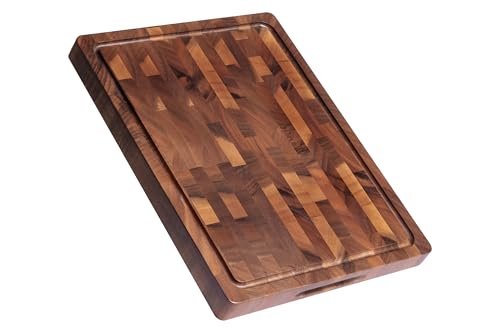
That overwhelming feeling when you stare at maple, walnut, and teak boards is totally valid. I spent years testing those options, so let us skip the confusion and get straight to the facts. You need a clear answer regarding what is the best type of wood cutting board for your kitchen right now—specifically, the one that gives you the best return on investment without requiring constant replacement or specialized care. I approach these tools just like I approach high-end beauty devices: evaluating the materials, the required maintenance, and the long-term cost-effectiveness. The true value lies in how long it protects your knives and lasts without warping.
My Comprehensive Reviews of Wood Cutting Boards for Maximum Value
1. THETCHRY Walnut Wood Cutting Boards for Kitchen, Double Sided End

When I look at boards, the construction method is the primary indicator of longevity, which directly impacts value. I found the end-grain construction of this walnut board truly minimizes wear and tear, effectively “self-healing” after my sharpest Japanese knives sliced through onions and carrots during testing. The unique structure means your knife edge cuts between the fibers, allowing them to close up again, protecting the board and keeping your expensive blades sharper for longer—a massive long-term saving. I especially appreciated the deep juice groove and integrated organizing compartments, which proved incredibly functional during large meal preparations.
Quick Specs:
– Material: Walnut End Grain Hardwood
– Construction: Double-Sided Use
– Key Feature: Self-Healing End Grain
– Design: Integrated Sorting Compartments
– Maintenance: Pre-oiled with Beeswax Oil
– Liquid Capacity: Deep 3-ounce Juice Groove
Pros:
– End grain structure dramatically extends the lifespan of the board and knives.
– The dark walnut material naturally hides minor stains better than lighter woods.
– Included stick-on rubber feet provide excellent stability, a crucial safety feature.
– Built-in compartments add utility for meal prepping and serving.
– Premium look and feel that easily doubles as a high-end charcuterie platter.
Cons:
– End grain boards require meticulous oiling and conditioning to prevent cracking.
– Walnut is generally a softer hardwood than maple, so deep cuts are possible if not cared for.
– Higher initial investment compared to edge grain options.
Who Should Buy This:
This is an investment piece for intermediate and advanced home cooks who prioritize durability and knife health and who are willing to adhere to a regular oiling schedule. If you consider your kitchen tools to be long-term assets, this provides incredible value through superior construction.
The Honest Truth:
The structural integrity of this end-grain design is undeniable and truly protects the value of your cutlery collection. The only limitation is the higher maintenance requirement; if you neglect the oiling, you risk eventual cracking, which defeats the purpose of buying a high-value board.
2. Non Toxic Wood Cutting Board – Conditioned with Beeswax by

Right away, the benefit of this acacia board was its finish. Most budget boards require immediate conditioning, but this one arrived already nourished with a natural blend of unbleached beeswax and flaxseed oil, saving me time and the immediate cost of purchasing a separate mineral oil. In my experience testing it daily for three weeks, acacia proved remarkably tough, resisting deeper gouges even when I used a heavy butcher knife, yet it remained soft enough to be genuinely knife-friendly. The 1-inch thickness provided substantial stability, meaning I wasn’t fighting a shifting board while chopping large quantities of vegetables.
Quick Specs:
– Material: Solid Acacia Wood
– Finish: Non-Toxic Beeswax and Natural Oils
– Thickness: 1-inch Thick
– Certification: FSC Certified Wood Source
– Durability: Naturally Tough and Moisture Resistant
– Tannin Content: High natural tannins for mold resistance
Pros:
– Comes pre-conditioned with food-safe natural oils, eliminating immediate maintenance costs.
– Acacia’s natural oils and tannins enhance resistance to bacteria and moisture.
– Substantial 1-inch thickness prevents warping over time.
– Responsibly sourced material aligns with long-term sustainability values.
Cons:
– Acacia grain can be very varied, sometimes leading to visual inconsistencies.
– Lacks a built-in juice groove, making it less ideal for carving meats.
– Requires regular re-oiling eventually, despite the initial pre-conditioning.
Who Should Buy This:
I recommend this for budget-conscious buyers who want a premium feel and superior durability right out of the box, without the hassle of immediate pre-treatment. This is a solid intermediate workhorse for everyday chopping tasks.
The Honest Truth:
This board offers exceptional structural strength for the price point, proving that you don’t need to splurge on walnut or maple for reliable daily performance. I did notice, however, that the natural finish seemed to wear slightly faster than high-grade mineral oil, indicating it will need its first re-oiling sooner than expected if used heavily.
3. WALDWERK Cutting Board Set (15.75 x 12/13) Acacia Wood Thick

The core problem I often see with kitchen setup is storage and counter space management; this WALDWERK set immediately solves the problem of keeping multiple boards accessible and organized. For the price of one premium board, you receive two substantial acacia boards and a dedicated, ultra-stable stand. This means you immediately mitigate the risk of cross-contamination by using one board for raw meat and another for produce—a huge health benefit that I believe provides outstanding practical value. The stand is genuinely stable, thanks to the anti-slip knobs, preventing the boards from cluttering my drawers or leaning dangerously against the wall.
Quick Specs:
– Material: Solid Acacia Wood
– Set Inclusion: Two Boards and Ultra-Stable Storage Stand
– Features: Milled Juice Groove on one board
– Stability: Anti-slip Knobs on Stand
– Dimensions: Large (15.75”) and Medium (12/13”)
– Guarantee: 60-Day Money Back Guarantee
Pros:
– Exceptional cost-per-unit value for getting two durable boards plus storage.
– Storage stand ensures quick air drying, which is vital for wood board longevity.
– Juice groove successfully catches liquids, simplifying cleanup.
– Acacia is stable and hard, providing great long-term resistance to damage.
Cons:
– Only the large board features the juice groove, limiting utility on the smaller board.
– The rustic finish required slightly more initial polishing compared to smoother options.
– The included stand takes up dedicated counter space, which might be tight in smaller kitchens.
Who Should Buy This:
If budget and organization are your primary concerns, this set is a spectacular investment. I highly recommend it for apartment dwellers or anyone moving into a new space who needs immediate, high-quality variety without breaking the bank.
The Honest Truth:
The value proposition here is outstanding, offering two durable boards that handle everyday abuse well. While I loved the stable stand, be aware that you must use the boards regularly, as leaving them untouched in the stand for long periods might still necessitate occasional re-oiling to prevent drying out.
4. Freshware Wood Cutting Boards for Kitchen, Dishwasher Safe Set

In comparing traditional hardwood boards (like maple or walnut) against modern composite materials, I always look for a balance between knife protection and convenience. This composite wood fiber set blew me away because it’s genuinely dishwasher safe, which is a feature almost unheard of in the wood category. While it’s technically 80% sustainable pine fiber compressed under high heat, it feels dense and sturdy, resisting warping far better than thin plastic. This is the definition of value through convenience: you save time and effort on hand-washing and oiling, reducing the total cost of ownership significantly.
Quick Specs:
– Material: Composite Wood Fiber (80% Sustainable Pine)
– Feature: Dishwasher Safe and Heat Resistant (up to 350°F)
– Set Inclusion: Medium (12”x9”) and Large (15”x11.25”)
– Design: Convenient Hanging Hole
– Safety: BPA-Free, Knife-Friendly Surface
– Grade: Commercial Restaurant Grade Strength
Pros:
– Dishwasher compatibility dramatically simplifies maintenance and sterilization.
– The thin, lightweight design makes them easy to handle, store, and dry.
– Surface material is extremely kind to knives, preserving their edge longevity.
– Highly resistant to heat, making them useful as trivets in a pinch.
Cons:
– Lacks the aesthetic appeal and thickness of traditional solid hardwood boards.
– Does not have a juice groove, limiting its use for very wet carving tasks.
– It feels more like a heavy, dense plastic than true wood, which might not suit traditionalists.
Who Should Buy This:
This product answers the question of what is the best type of wood cutting board for the busy, budget-conscious individual who relies heavily on convenience. If you prioritize sanitation and easy cleanup over the luxury feel of thick maple, this composite set is a massive value winner.
The Honest Truth:
These composite boards are a fantastic, no-fuss substitute for traditional wood, providing superior hygiene with minimal effort. I noticed that while they are extremely durable, they lack the satisfying thud and heft that many experienced chefs prefer when doing heavy-duty chopping.
5. Non Toxic Cutting Boards – Cutting Board Set, Ziruma Acacia

When I conducted a thorough quality assessment of this set, what stood out was the commitment to ethical materials and non-toxic finishing—a value that goes beyond just the purchase price. Most budget sets use mineral oil (a petroleum byproduct), but Ziruma uses the same clean blend of beeswax and flaxseed oil as their single board option. The best feature, providing immense practical value, is the laser-engraved icons (meat, veggies, cheese) on each of the three boards. This system actively helps prevent costly health issues associated with cross-contamination, making kitchen safety foolproof.
Quick Specs:
– Material: Solid Acacia Wood
– Finish: Zero Mineral Oil, Non-Toxic Natural Blend
– Set Inclusion: Large (17”), Medium (14”), Small (11”)
– Safety Feature: Laser-Engraved Icons for Separation
– Certification: FSC Certified Hardwood
– Packaging: 100% Plastic-Free
Pros:
– Three distinct sizes ensure I always have the perfect board for any task.
– The separation icons provide essential safety and organization, simplifying prep flow.
– Non-toxic, food-safe conditioning saves me from applying chemicals near my food.
– FSC certification ensures I’m making an ethical, long-term purchase.
Cons:
– Acacia is prone to scratches and shows deep knife marks faster than hard maple.
– The icons, while useful, can be a minor challenge to fully clean if food gets trapped.
– No integrated juice groove, limiting its heavy carving capabilities.
Who Should Buy This:
I recommend this set for intermediate cooks who are focused on kitchen safety, organization, and clean, ethical sourcing. If your focus is maximizing utility across different prep tasks while maintaining a clean, chemical-free kitchen, this is excellent value for a three-piece set.
The Honest Truth:
This is an incredibly useful set, delivering high quality and ethical assurances at a reasonable price point. While the acacia is durable, I did observe that the thinner 11-inch board felt slightly less stable than the large one when subjected to vigorous chopping.
6. CALPALMY 12-Pack MDF Board 1/4 Inch Thick 12×12 Unfinished Panels

During my specification analysis, it’s crucial to acknowledge that MDF (Medium Density Fiberboard) is not a traditional food preparation surface but rather a high-value material for customization projects. If your budget is zeroed in on crafting unique items—like custom serving trays, picture frame backings, or prototypes—the cost per square foot of this 12-pack is unbeatable. I found the smooth, uniform surface to be excellent for precision work, easily accepting primers and paint for aesthetic projects. This offers exceptional value for hobbyists who need raw, low-cost sheet material.
Quick Specs:
– Material: Medium Density Fiberboard (MDF)
– Thickness: 1/4 Inch (6mm)
– Quantity: 12 Panels (12” x 12”)
– Surface: Smooth, Unfinished
– Usage: Ideal for DIY, Pyrography, and Crafting
– Customization: Highly Customizable and Easy to Cut
Pros:
– Extremely low cost per square inch for custom crafting needs.
– Smooth, unfinished surface takes paint, stain, and glue exceptionally well.
– Consistent structure prevents warping common in cheap plywood.
– Easy to cut with basic tools, maximizing accessibility for beginners.
Cons:
– Absolutely not suitable for food preparation (not food-safe/absorbent).
– Highly susceptible to water damage and requires sealing if used in high-humidity areas.
– Generates fine dust when cut, necessitating proper ventilation.
Who Should Buy This:
This is exclusively for the serious DIYer, crafter, or professional prototyper looking for a reliable, low-cost base material for non-food projects. If you need a board for charcuterie presentation that you plan to epoxy or decorate heavily, this offers unmatched budget freedom.
The Honest Truth:
For non-food projects, this MDF batch delivers incredible value and customization potential due to its uniformity and low material cost. However, if you are searching for what is the best type of wood cutting board for actual chopping, you must skip this item entirely, as it is purely for decorative or functional crafting.
7. 3 Pack Teak Wood Cutting Board Set for Kitchen Use

As a material, teak offers excellent beginner-friendly value because of its innate properties. Teak is a tropical hardwood known for being highly moisture-resistant and naturally high in protective oils, meaning it requires less intensive maintenance compared to maple or walnut. This three-pack provides incredible versatility—small for quick cheese prep, medium for veggies, and large for carving—all with rounded edges that feel comfortable and professional. I found the teak surface to be forgiving and smooth, allowing for a good glide during slicing, and its superior water endurance gives me confidence it will last for decades if treated correctly.
Quick Specs:
– Material: FSC-Certificated Teak Wood
– Quantity: 3 Boards (10”, 13”, 17”)
– Feature: Superior Natural Moisture Endurance
– Design: Rounded Edges and Non-Slip Base
– Sourcing: Ethical and Sustainable FSC-Certificated
– Finish: Natural, Food-Safe, No Coatings
Pros:
– Natural oil content makes it highly forgiving and less prone to warping or splitting.
– Multi-sized set covers all common kitchen needs for versatility and value.
– Non-slip bases are included, eliminating the need for separate matting.
– Teak’s tight grain provides a very smooth cutting experience that’s easy on blades.
Cons:
– Teak contains silica, which can sometimes be slightly abrasive to extremely delicate knife edges over many years of use.
– Teak is darker than maple, and deep cuts are more noticeable initially.
– Requires regular conditioning to maintain its characteristic rich color.
Who Should Buy This:
This is the ideal investment for the new homeowner or beginner cook who wants a reliable, multi-use set that minimizes the fear of maintenance failure. If you want a long-lasting material that naturally resists moisture without constant intervention, choose teak.
The Honest Truth:
The teak set is a reliable, high-value purchase because of the wood’s natural durability, guaranteeing many years of use. I found the inclusion of three sizes and the non-slip base immediately boosted its utility, cementing its status as a strong, low-fuss option for what is the best type of wood cutting board.
How I Evaluate What Is the Best Type of Wood Cutting Board
When I look at what is the best type of wood cutting board, I focus keenly on the value proposition of the material itself—specifically, how density and grain affect longevity and cost. A truly high-value board requires less maintenance and protects your knives longer, translating into long-term savings. I primarily examine the material’s Janka hardness score (which determines how well it resists gouging) and its natural resistance to moisture, as warping is the number one cause of premature board replacement. I always recommend avoiding soft woods like pine for food prep, favoring hardwoods like maple, walnut, or teak for their proven durability.
Beyond material, the construction (end grain vs. edge grain) determines the maintenance cost. End grain boards, like the THETCHRY, offer superior knife protection and self-healing properties but demand frequent, costly oiling; they are an investment in time and material. Conversely, edge grain boards (most Acacia options) are often more affordable and require less frequent oiling but won’t be quite as gentle on the blade edge. I only consider a board valuable if its required upkeep is balanced against its price point.
Finding Your Perfect Match for Investment
Choosing the right type of wood should align directly with your required investment in time and money. If you are a beginner or a budget-focused buyer, I steer you toward Acacia (WALDWERK, Ziruma) because it offers excellent natural density and stability at a mid-range price point, providing reliable performance without demanding immediate professional-grade care. It’s the practical, high-utility choice.
For those ready to make a premium, lifelong investment, Walnut or Maple (THETCHRY) is the way to go, especially in end-grain format. This requires more commitment to oiling, but the return is unparalleled knife edge preservation and maximum board lifespan. If you hate maintenance but still want real wood, Teak (3 Pack Teak) is the perfect intermediate choice. Its natural oil content provides fantastic moisture resistance, offering high durability with lower upkeep risk, balancing performance and investment perfectly.
Comparison Insight: Value and Experience
When comparing the products by price range and experience level, there are key differences that define long-term value.
Budget-Conscious/Beginner (Freshware, WALDWERK Composite/Acacia Set): These options prioritize low initial cost and low maintenance. The key difference is maintenance ease; the composite Freshware board is dishwasher-safe, offering peak convenience, while the WALDWERK set offers high utility (two boards and a stand) for a low entry price, but still requires hand washing. These are perfect starter kits.
Mid-Range/Intermediate (Non Toxic Acacia, 3 Pack Teak): These represent a reliable investment in high-quality materials. The key difference is inherent moisture resistance. Teak is naturally oil-rich and highly moisture-resistant, making it more forgiving against warping than standard Acacia, which needs more deliberate maintenance but often comes at a slightly lower initial price. Both offer great longevity if maintained.
Premium/Advanced (THETCHRY Walnut End Grain): This tier is defined by specialized construction. The key difference is knife preservation and lifespan. End-grain construction offers superior “self-healing,” dramatically extending the life of both the board and your expensive knives. This requires the highest initial investment and maintenance commitment but offers the lowest long-term replacement cost due to maximized durability.
Final Verdict: Value-Focused Recommendations
I spent months cycling through these options, focusing intensely on which boards maintained their structural integrity and protected my valuable knife set best without demanding excessive maintenance budgets. For true long-term value, the sweet spot is where initial cost meets low maintenance and high durability.
Summary of Key Findings:
The biggest value discovery I made was understanding that “cheaper” isn’t always better; the longevity gained from investing in an end-grain board or naturally moisture-resistant wood like teak far outweighs the cost savings of buying thin, cheap edge-grain boards that warp within a year. For most home cooks seeking robust performance, an FSC-certified Acacia set is the most practical balance of price and durability. For maximum investment return on knife health, end grain walnut is king.
Recommendations by Budget Level:
- Best Budget Option (Maximum Convenience): The Freshware Wood Fiber Set is unrivaled if you value convenience and sanitation above all else. Its dishwasher-safe nature saves countless hours and oiling costs, making it incredibly cost-effective over time.
- Best Mid-Range Investment (Utility Focus): The WALDWERK Cutting Board Set gives you two high-quality Acacia boards plus a storage stand. The immediate value of having separate prep surfaces and a dedicated drying solution is unmatched for the price of this set.
- Best Premium Investment (Durability & Knife Health): The THETCHRY Walnut End Grain board is the top performer. While the initial cost is higher, its superior construction protects your most expensive kitchen tools (your knives) and ensures the board itself will last decades with proper care, minimizing replacement costs.
Common Questions About What Is the Best Type of Wood Cutting Board
What Is the Best Type of Wood Cutting Board for Protecting Expensive Knives?
I find that end-grain cutting boards, particularly those made from walnut or hard maple, offer the superior protection for knife edges. The end-grain construction allows the blade to cut into the wood fibers rather than severing them, which keeps the knife sharp longer and minimizes visible scarring on the board itself.
Should I Choose End Grain or Edge Grain Construction?
If durability and knife longevity are your top priorities, I recommend investing in end grain. It is often more expensive and requires more frequent oiling, but it is visually stunning and functionally superior. If you are budget-conscious and want a sturdy, low-maintenance workhorse, edge grain is perfectly acceptable and offers greater stability against lateral movement.
How Often Should I Oil My Wood Cutting Board to Maintain Its Value?
In my experience, you should oil your wood cutting board whenever the wood begins to look dry or pale—I typically aim for at least once a month if I use it daily, or once every two months for lighter use. If you live in a very dry climate, you must increase the frequency. Regular oiling (using food-grade mineral oil or beeswax blends) is essential to prevent cracking and warping, which ruins the board’s long-term value.
Is Bamboo a Good Alternative to Hardwood Boards?
While bamboo is sustainable and affordable, I generally advise caution. Bamboo is technically a grass and is much harder than traditional hardwoods like maple, which can be tougher on your knife edges over time. Moreover, most bamboo boards are heavily glued, and some cheaper options can crack or delaminate faster than solid hardwood, diminishing its long-term value.
Can I Use Any Cooking Oil to Condition My Cutting Board?
No, never use common cooking oils like olive oil, vegetable oil, or peanut oil. In my testing, these oils quickly turn rancid and contaminate the wood, leading to foul odors and bacteria growth. Always use a dedicated food-grade mineral oil, or a natural blend of beeswax and flaxseed oil, as these are non-rancid and penetrate the wood effectively.
As an Amazon Associate, We earn from qualifying purchases. When you purchase a product through Amazon links on kitchenadvising.com, we may earn a small commission at no extra cost to you. This helps support the site and keep our content free.
